
Corps values: Two ballerinas share the key to keeping a strong and striking ensemble
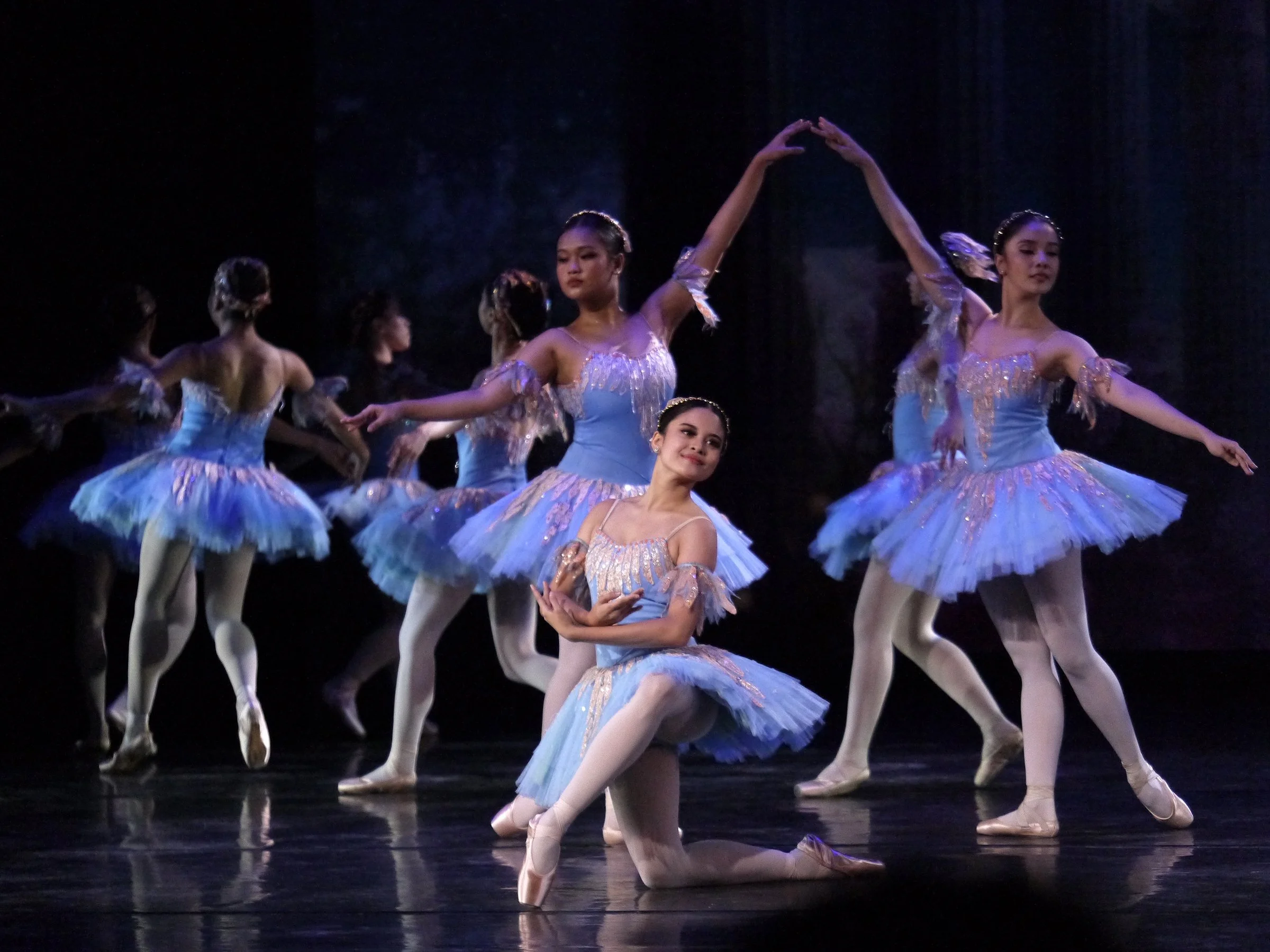
Company artists Marinette Franco (right) and Angelika Tagupa (front) – as dryads or mythical nymphs in Act 2 of Don Quixote (2023) – are very serious about upholding the tradition of “being a single organism” on stage.
By Jv Ramos
Photos by Giselle P. Kasilag
Ballet Manila has always been known for having a strong corps de ballet. As longtime
members of it – their experience in fact started when they were still an apprentice and trainee, respectively – company artists Marinette Franco and Angelika Tagupa take a lot of pride in corps dancing and are very serious about upholding the tradition of “being a single organism” on stage.
Ballet Manila is well known for its strong corps de ballet, as seen in its performances of the most challenging full-length classical works such as Giselle (2024).
“While I don’t remember everything about my first time being included in the corps, I do
remember the ates (older and more experienced ballerinas) being very competitive about whose side can produce better lines or get lesser corrections,” recalls Marinette, who began being included in Ballet Manila’s corps ten years ago. “And no, they were not joking about their tarayan (snippiness). They’d really give you the look when you’re the one who messes up and the other line is the one that gets the praise. I remember feeling guilty or scared about being the one who messes up when I was a teenager.”
“Wala namang tarayan when I entered in 2018. That was for the American Stars Gala performance of Swan Lake Act 2, but I felt that all the girls wanted to get everything right because they have been rehearsing for so long and didn’t want to prolong things anymore when we, the students from other classes, joined,” chimes in Angelika who had been plucked out of the Lisa Macuja School of Ballet’s Fisher Mall branch to join the corps as a trainee.

Ballet Manila’s female corps shows its fine form in Swan Lake (2025). During the company’s tour in Dumaguete, they were the star attraction in six shows of the ballet classic performed over three days.
“So I do remember the feeling of also not wanting to mess things up around the older ballerinas! My first time doing corps work was such an eyeopener! I didn’t grow up with dancers around me doing corps, so when I was added to the group, I felt that I wasn’t doing anything right,” says Angelika.
“Having grown up here in Pasay (Ballet Manila’s main studio), and seeing corps work being done every day, I can tell you that it doesn’t help much,” claims Marinette. “When you do corps for the first time, you really feel that you aren’t doing anything right. It really takes experience to be a good member of the corps. Like everyone else, you have to adjust a lot in the beginning, but as you rehearse more and more, you cannot be adjusting forever. You have to learn how to do things.”
Agreeing that corps work is always difficult at first, the two company artists list the values that they feel a corps de ballet member should have. Angelika declares, “I think the first would have to be awareness of everything around you! You really have to know what’s happening, so you know how to move.”
Marinette Franco: “Corps work really isn’t for everyone. You’d have to be okay with not standing out!”
Both ballerinas stress that it’s not enough to know what the person in front and beside them are doing; a ballerina must have a 360-degree perspective. “What people get wrong about corps work is it is all about lines. It’s not,” adds Marinette. “You also have to think about the soloist roles. You have to ask, as you’re dancing, are we giving the soloists enough space when they enter? You also must know what’s happening before and what’s happening next in every performance, so you’re not in the way of other dancers. There’s also having to communicate what you’re observing on stage with the other side of the corps, so you can make necessary adjustments.”
She continues, “A quality that’s equally important for me is good memorization and fast
pick-up, because if things are being taught repeatedly, the choreographic process can get interrupted.” This company artist claims that such value is especially useful in Ballet Manila as artistic director Lisa Macuja Elizalde “choreographs as fast as she used to dance on stage.”

Les Sylphides (2019) was another white ballet that challenged the corps, requiring keen awareness, good memorization and fast pick-up.
There’s also the reasoning wherein if one memorizes quickly, one avoids tiring out the other ballerinas who are correctly doing things. “You need quick pick-up too, because any time, something can happen to another ballerina, and you’d have to take her place in the corps,” shares Angelika, who herself had to learn dancing five other parts in Sotto Voce by Augustus “Bam” Damian III just so rehearsal and shows could run smoothly.
“Hindi ka rin puwedeng bida-bida sa corps (You can’t be a show-off in the corps),” underscores Marinette. “The main idea of being in the corps is to move as one or to be synchronized, and that takes a lot of humility from dancers. Corps work really isn’t for everyone. You’d have to be okay with not standing out!”
And while one is meant to be identical with the rest, the two dancers reject the idea that there are no unique personalities among the corps. “Dancers that are sensitive to corrections or criticism can still be good corps members,” confirms Marinette. “I tend to complain or cry when there’s heavy workload, but in the end, I pick myself up – with the help of a little McDo – and perform like nothing’s wrong in the next Swan Lake tour show.”
Angelika Tagupa: “The way to improve is to keep dancing and communicating with each other in and out of rehearsals.”
“I think also that in corps work, the way to improve is to keep dancing and communicating with each other in and out of rehearsals,” observes Angelika. She shares that since the post-pandemic corps de ballet of Ballet Manila has done demanding white ballets like Giselle and Swan Lake, they know how to “read” each other, establish the same tempo even without music, and move as a single organism. “There really are ballets that push you all to become a better corps. After our Swan Lake tour in Dumaguete, everything we’ve done felt easy to do – from Don Quixote to even Paquita.”
Ballet Manila had performed a sold-out, six-show run of Swan Lake in July 2025 at Silliman University's Claire Isabel McGill Luce Auditorium in Dumaguete City. While it admittedly took a toll on the corps de ballet, with two shows being performed each day, the reward came in the wild applause and the glowing reviews that came their way.
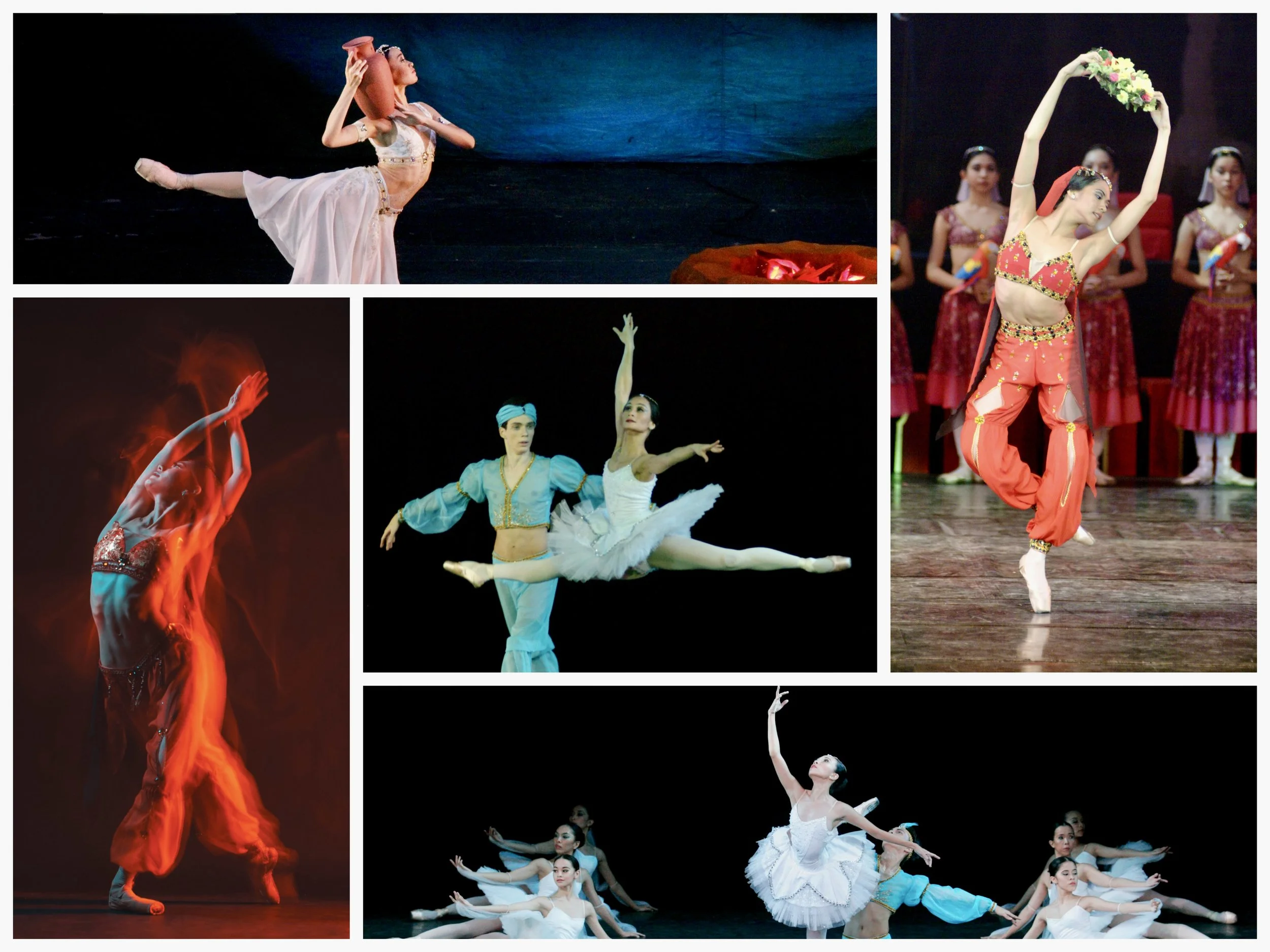
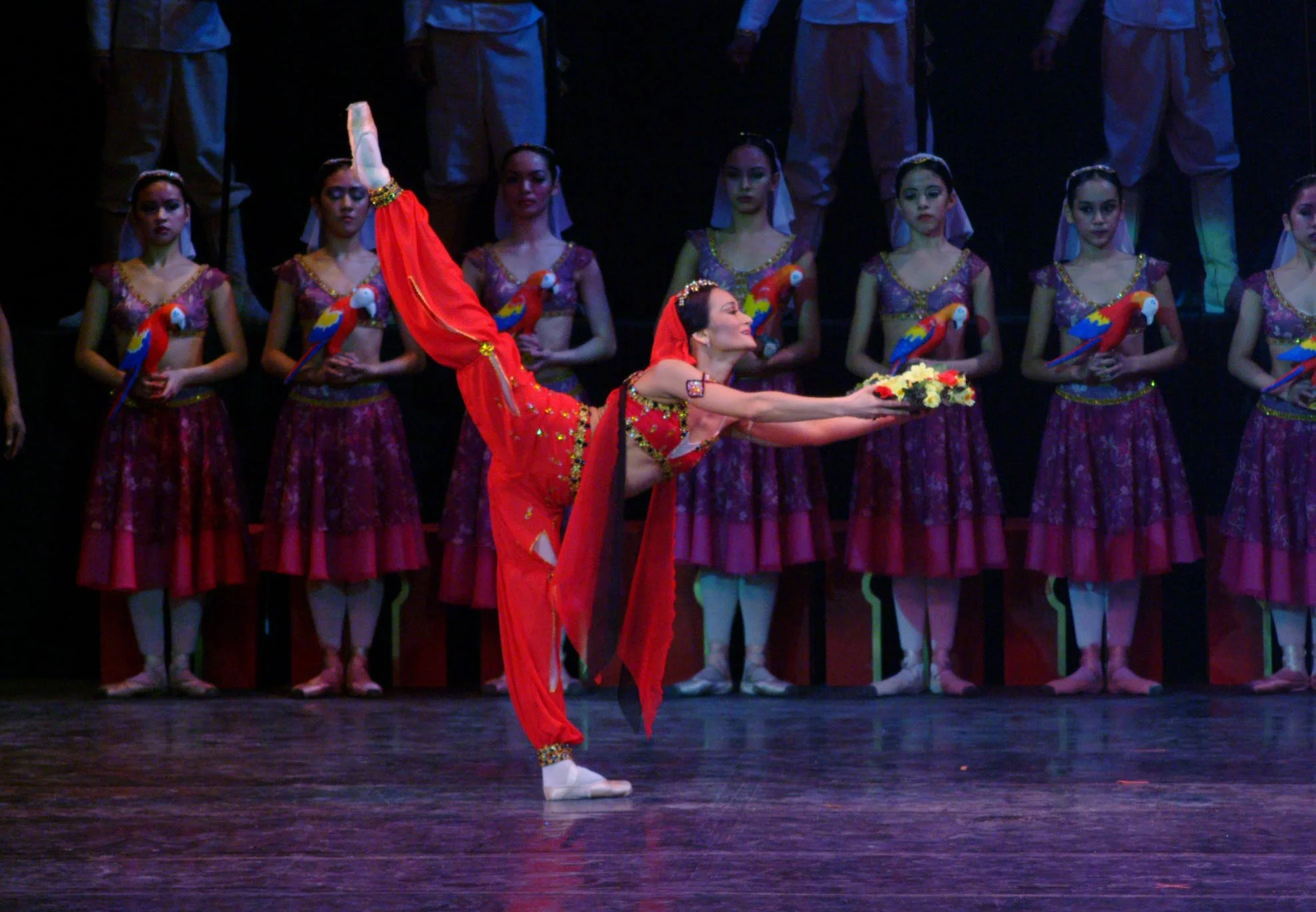
The Naila Waltz in Le Corsaire (2024) is always a showstopper where the corps de ballet gets to display its ability to be in sync.
Shortly after returning to Manila then, artistic director Lisa Macuja Elizalde had described what happened in the tour for balletmanilaarchives.com: “What I think no other company has ever done is three double-show days of Swan Lake in a row – as a result of the delays and re-scheduling of the shows. It was very difficult for everyone, especially the girls who were in all four acts! That’s eight acts every day for three days! On the third day, many were in tears due to exhaustion; and we also had to deal with some changes in blocking and casting because one dancer got sick. But we carried on. Everyone did their bit! It was an amazing experience!”
“I really feel that after Swan Lake, the next big challenge for us corps ballerinas is La
Bayadere,” informs Marinette. Aside from the piece itself being technically demanding, Ballet Manila’s last performance of this tragic love story set in India happened 13 years ago. “Not a lot of us have experienced dancing even just the Kingdom of the Shades, and we are doing all the acts with just six weeks of rehearsals. But it can be done! Everyone just has to do their part.”
The famed Kingdom of the Shades from La Bayadere opened Ballet Manila’s BM 21 production in 2016, marking the start of the company’s 21st performance season.
The Kingdom of the Shades is the iconic part in Act 3 of La Bayadere where dozens of ballerinas in white tutus and veils descend upon the stage one by one in an astounding display of classical tradition. As Lisa puts it, “It propels our girls into some of the most intricate group dancing created for classical ballet. It’s a demanding showpiece that highlights the corps de ballet’s control and discipline because all the dancing is done in slow motion. It is the act that is considered the most dreaded by a company’s female corps de ballet. Ballet Manila is the only ballet company in the Philippines that has this kind of superior corps de ballet ensemble.”
Company artists like Angelika and Marinette feel the weight of having to live up to that reputation. And they realize that relying on one another and trusting in their collective abilities will help them achieve that desired goal.
“Marinette has been very good with making us a better corps,” Angelika points out. “She’s not afraid to tell me if I’m doing something wrong. She’s been our spokesperson and the one who pressures us to learn things already. Corps is also about supporting and pushing each other!”
The two share that they have gone easy on the younger and newer dancers in early rehearsals. “But when August comes, and they still are making mistakes as we enter the Aliw Theater, I’ll start calling them out,” says Marinette who was co-artistic associate Eileen Lopez’s point person in the Swan Lake corps in Dumaguete. “It’s part of your job to study the dance. Actually, even as we’re being taught what to do, you’re supposed to know the gist of the corps work by watching the video given to us.”
Finally, Marinette and Angelika put forward that while one cannot stand out as a member of the corps, as a group, they are able to uplift every performance when they do well.
“What we crave for after every show are pointers, because we want to improve the next show, and since corps work involves everyone being in sync, there’s so much more fulfillment in being told that the corps did well,” sums up Marinette.