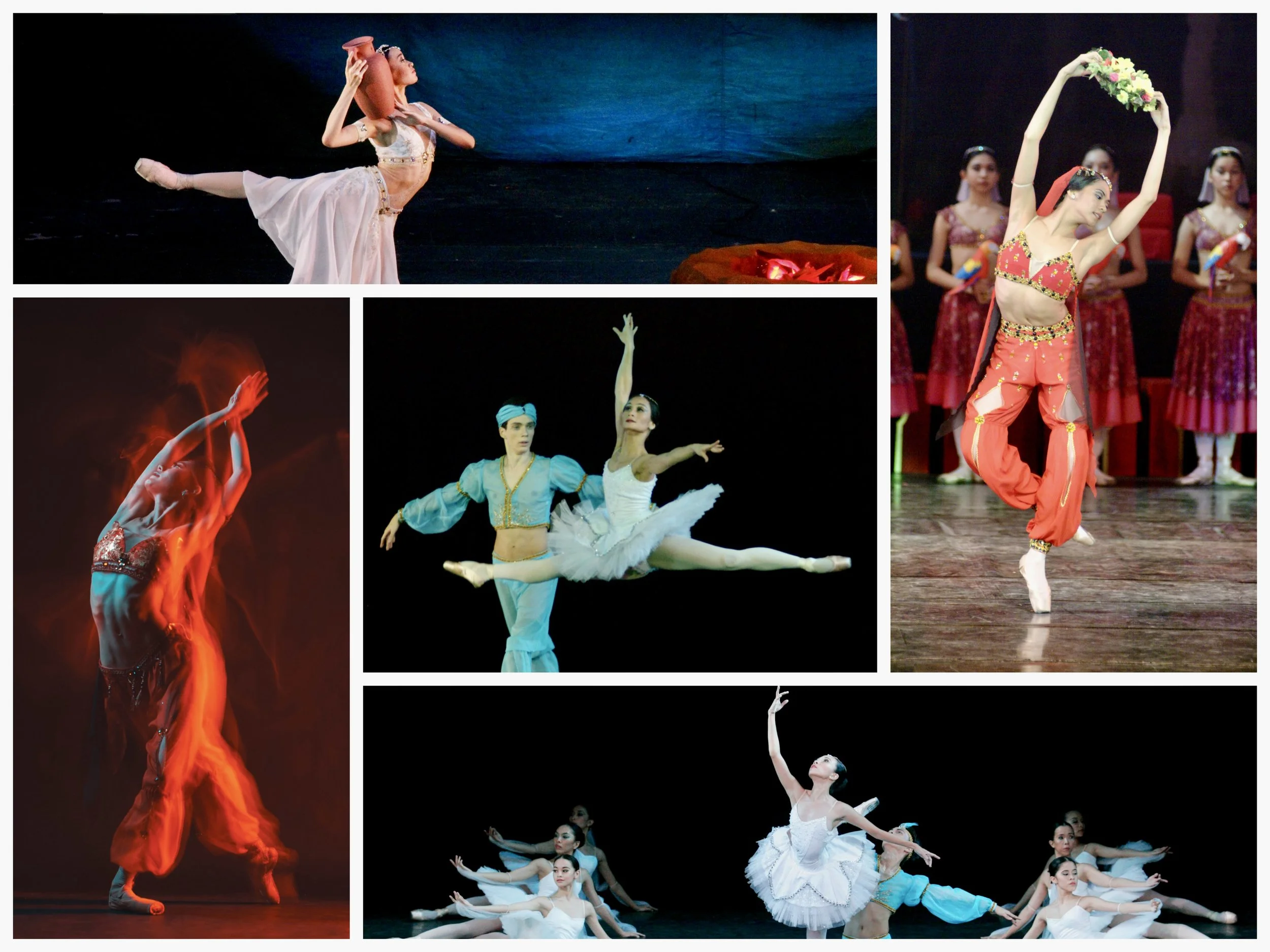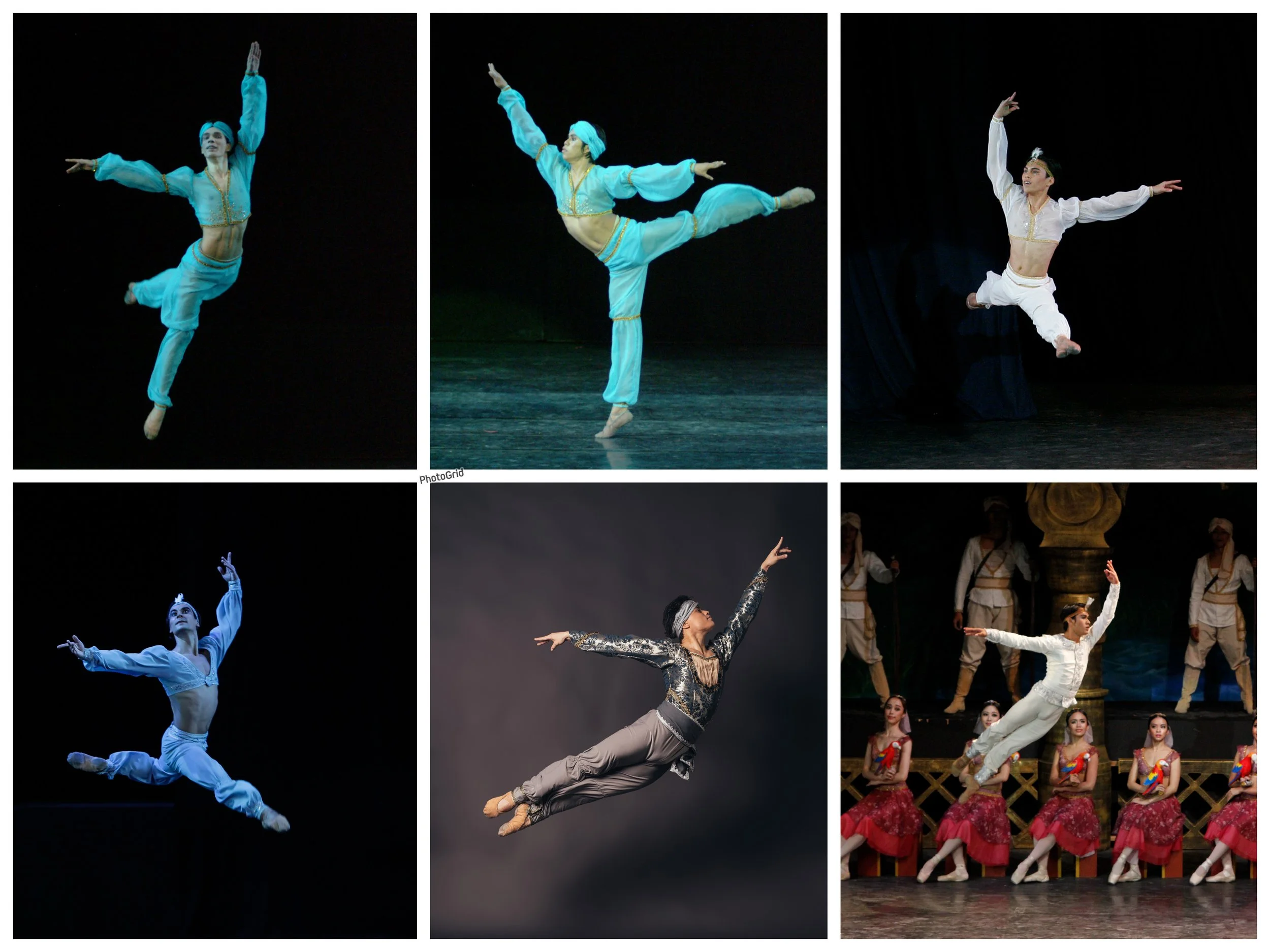
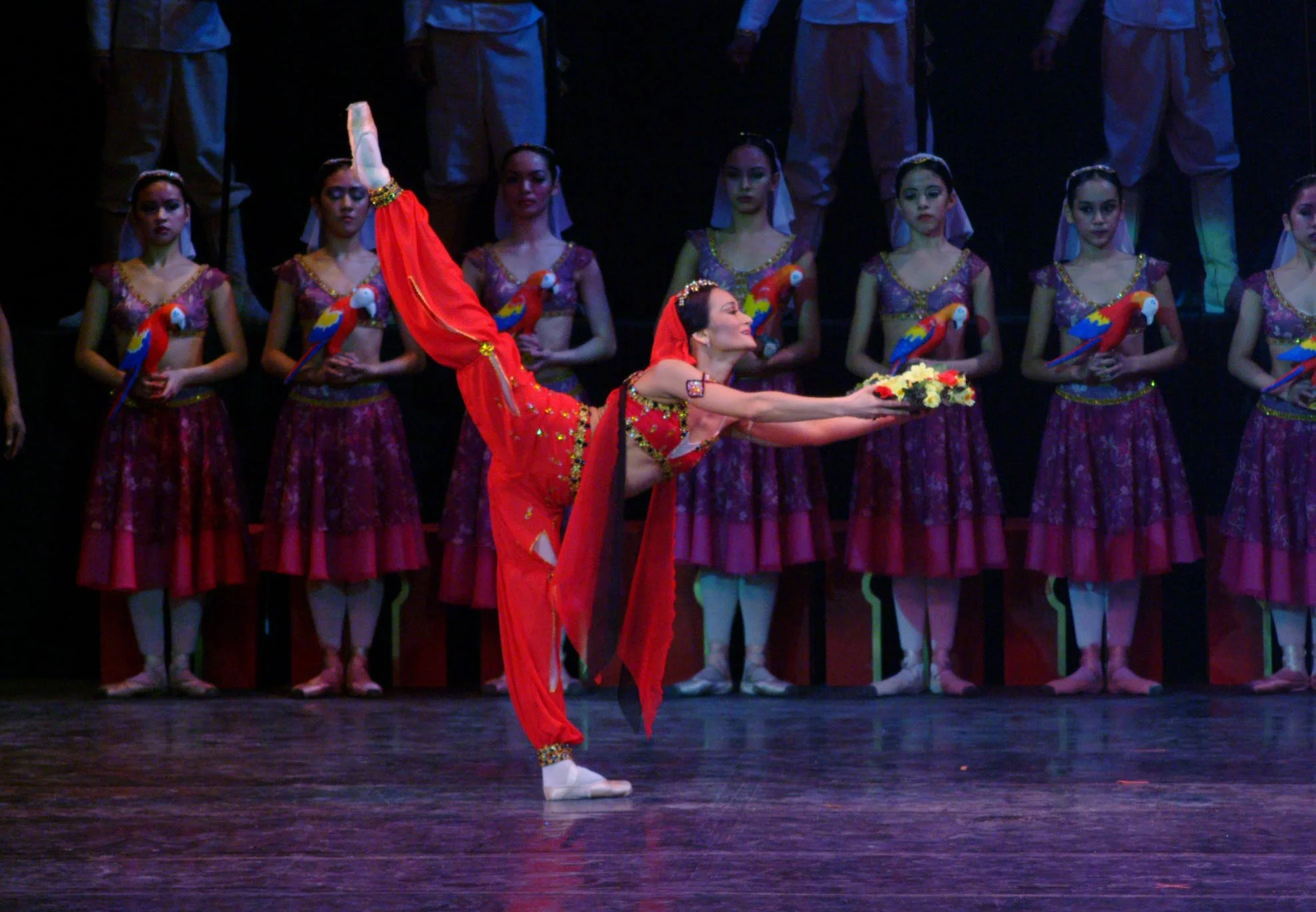
La Bayadere: A spectacle of a ballet
La Bayadere at the Imperial Mariinsky Theater in 1900, with Pavel Gerdt as Solor and Matilda Kschessinskaya as Nikiya, featured lavish sets and costumes.
Lavish does not come close to describing the spectacle that is La Bayadere. Marius Petipa’s most popular exotic ballet premiered in 1877 at the Imperial Bolshoi Kamenny Theatre, Saint Petersburg to an appreciative audience that immediately hailed it as a masterpiece. But this ballet’s journey to the stage was equally epic. Nearly a century and a half later, it continues to be immersed in controversies while enjoying critical acclaim.

Prima ballerina Ekaterina Vazem was the very first Nikiya of La Bayadere in 1877. Vazem would later become the teacher of Anna Pavlova.
Set in Ancient India, La Bayadere follows the story of a temple dancer named Nikiya, a warrior named Solor and their undying love that sets off a series of events leading to a tragic end.
It was not the first ballet to feature an Indian temple dancer. Filippo Taglioni’s Le Dieu et la Bayadère premiered in Paris in 1830. Petipa himself danced in Le Dieu et La Bayadère in Bordeaux in 1854. The West’s infatuation with India was further heightened by the visit of the Prince of Wales to the country in 1875. All these would have inspired the choreographer to develop his own version.
Marius Petipa being Marius Petipa, however, meant a creating a ballet that is grander in scale than anything that came before it. The result was a four-act ballet that delivered what it promised – lavish, opulent and extravagant in every way possible.
Credits for the libretto was shared by Petipa and Sergei Khudekov. The music was written by ballet legend Ludwig Minkus. The sets were created by no less than five designers: Mikhail Bocharov (Act 1, scene 1), Matvei Shishkov (Act 1, Scene 2 and Act 2), Ivan Andreyev (Act 3, Scenes 1 and 3), Heinrich Wagner (Act 3, Scene 2) and Andrei Roller (Act 4 and apotheosis). The costumes were created by Ivan Panov.
Lev Ivanov, premiere danseur of the St. Petersburg Imperial Ballet, was the very first Solor of La Bayadere in 1877. He was also the company’s ballet master and would later become a well-known choreographer.
The original cast listed prima ballerina Ekaterina Vazem as Nikiya, Lev Ivanov as Solor, Maria Gorshenkova as Hamsatti, Nikolai Goltz as The Great Brahmin and Christian Johansson as The Rajah. La Bayadere was actually created for a benefit performance of Vazem which she later on described as her favorite ballet.
La Bayadere had all the elements of a hit but the road to the stage was fraught with challenges. They had six months to prepare, and Petipa’s grand vision came with an equally grand price tag. The sets were complicated and machinists were employed to ensure that the palace destruction scene was carried out safely.
A live tiger was also used in the original staging which carried its own set of challenges especially in making sure that no member of the cast, crew and audience got hurt from the rehearsals to the last performance.
The Kingdom of the Shades in Act 3 required 64 dancers descending from an illuminated castle in the sky. Drawing inspiration from Dante’s Paradiso in The Divine Comedy, the entrance of the Shades relied on the massive number of dancers moving cleanly and in unison to create an impression of the ethereal.
Rudolf Nureyev and Margot Fonteyn performed as Solor and Nikiya in a staging of The Kingdom of the Shades with the Royal Ballet in 1963.
Here is how the Petipa Society described the scene: “Each of the dancers makes her entrance one by one down a long winding ramp from upstage right with a simple arabesque (fondu) and into cambré, followed by an arching of the torso with arms in fifth position, followed by two steps forward. With the last two steps, she makes room for her sister shade and the combination continues thus in a serpentine pattern until the entire corps de ballet has filled the stage in eight rows of eight. Then follows simple movements en adage to the end. Petipa left the Entrance of the Shades free of technical complexity – the unison of the whole and the effect of the descending ballerinas is the challenge as a mistake from one dancer would spoil the entire scenario.”
Further complicating matters was the theater director’s decision to raise the ticket prices. It was pegged higher than the Italian opera which was already very expensive. Petipa was worried that he would open to an empty house.
But come opening night, it was clear he had no reason to fear. La Bayadere was declared a success by critics and ballet fans alike, with The Kingdom of the Shades immediately becoming a crowd favorite.
Mariinsky Ballet’s Maxim Chashchegorov bows before prima ballerina Lisa Macuja Elizalde after their performance together in La Bayadere in 2006. It was the second time the two were paired in the lead roles in the epic ballet. Photo by Ocs Alvarez
It was restaged in 1900 with Pavel Gerdt as Solor, Matilda Kschessinskaya as Nikiya and Olga Preobrazhenskaya as Gamzatti which was previously Hamsatti. Variations were added for Nikiya and Gamzatti as well as other minor characters. But the most significant change in this staging – the final one by Petipa – was in Act 3. Rather than descending from a castle, the Shades were now descending from the Himalayas. Instead of 64 dancers, the number was reduced to 48.
In Ballet Manila’s first performance of the full-length La Bayadere in 2004, Lisa Macuja Elizalde made her debut as the temple dancer Nikiya whose love for the warrior Solor ends in tragedy. Photo by Ocs Alvarez
The biggest controversy about La Bayadere that has divided the ballet community was the lack of the Indian values and contexts in the dance and music despite being set in Ancient India. While the sets and costumes clearly depicted the culture, the music and the choreography did not stray from the classical ballet canon.
While La Bayadere became a classic in Russia, it took decades before it was “discovered” by the rest of the world. The first western production featured only The Kingdom of the Shades. It was mounted by Eugenia Feodorova at the Teatro Municipal in Rio de Janeiro, Brazil in 1961 with Bertha Rosanova as Nikiya and Aldo Lotufo as Solor.
It was the performance of that same excerpt in Paris, also in 1961, that finally caught the attention of the rest of the world. Two years later, Rudolf Nureyev restaged it for the Royal Ballet with Margot Fonteyn as Nikiya.
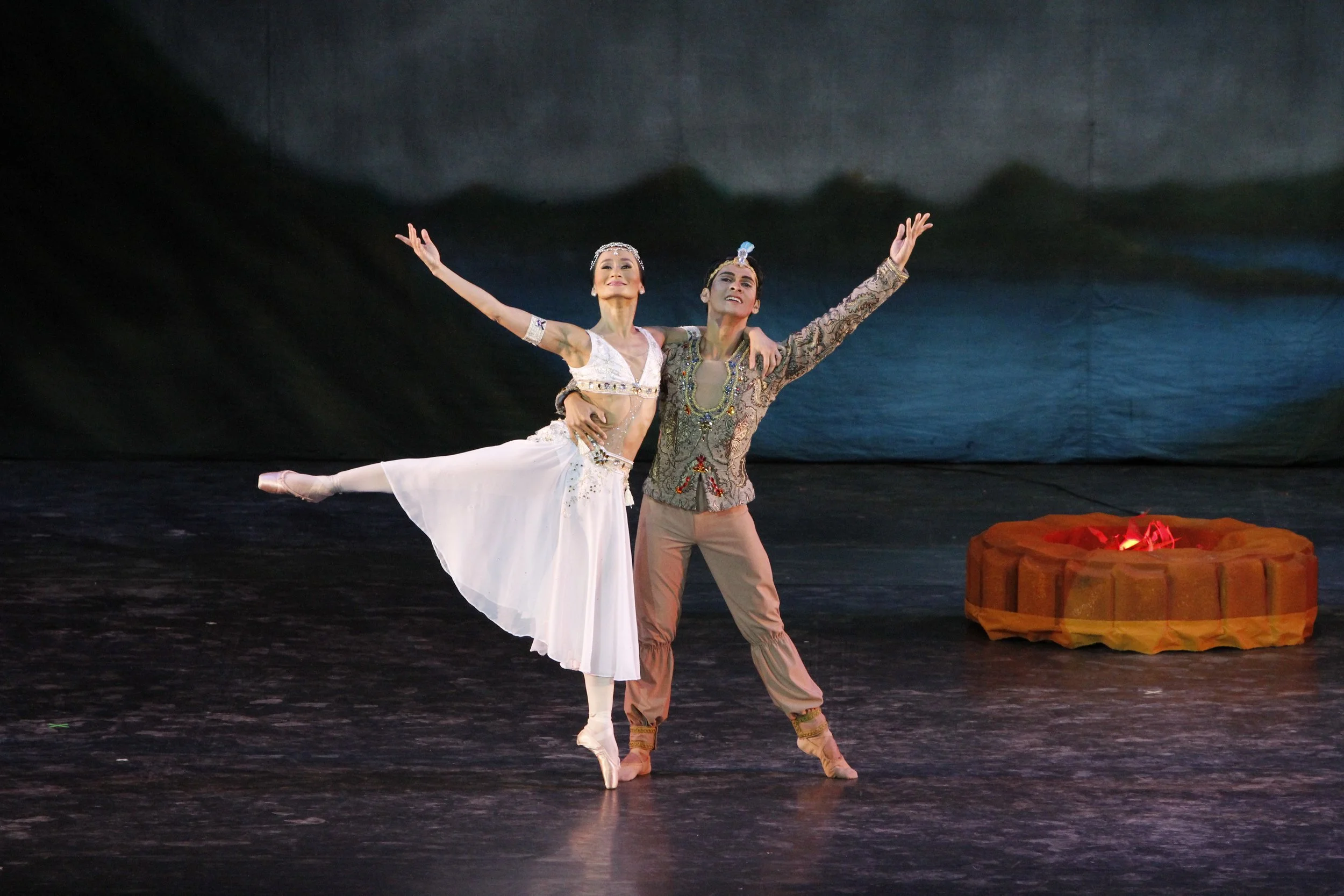
For her Swan Song Series in 2013, Ballet Manila artistic director Lisa Macuja Elizalde danced as Nikiya to principal dancer Rudy De Dios’ Solor in La Bayadere. Photo by Ocs Alvarez
Even then, not many ballet companies today have included La Bayadere in their regular repertoire. The artistic and technical requirements that it demands from the dancers along with the grand and complicated scale of the production has made staging La Bayadere expensive and difficult.
Ballet Manila counts itself among the shortlist of companies that has kept La Bayadere in its regular roster of classical ballets. It has performed the full-length piece three times with People’s Artist of Russia Sergey Vikulov and Merited Artist of Russia Tatiana Alexandrovna Udalenkova at the helm of the first staging in 2004.
It was restaged in 2006, and for Ballet Manila artistic director Lisa Macuja Elizalde’s Swan Song Series in 2013.
The Kingdom of the Shades is the iconic highlight in Act 3 of La Bayadere, performed by Ballet Manila in 2013.
La Bayadere will return to Aliw Theater this August with Mariinsky Ballet’s Renata Shakirova and Kimin Kim as Nikiya and Solor, alternating with Ballet Manila’s very own principal dancer Abigail Oliveiro and soloist Noah Esplana who are taking on the lead roles for the first time. Oliveiro will be holding a double debut as she will be performing Gamzatti for Shakirova and Kim. Alternating for the role is soloist Shamira Drapete who will be dancing as Gamzatti for the first time as well.
Beyond the lavish production and the technical demands of the ballet, La Bayadere at its core is a love story. It is a promise of love that was broken, mended and healed – a tale that anyone from any age or culture can relate to.